
Capturing the Cosmic Essence: The Sacred Syllable AUM in Tamil and the Morning Radiance Gracing Each Other During Sunrise
Kevala Yoga Wellness | JUL 1, 2024
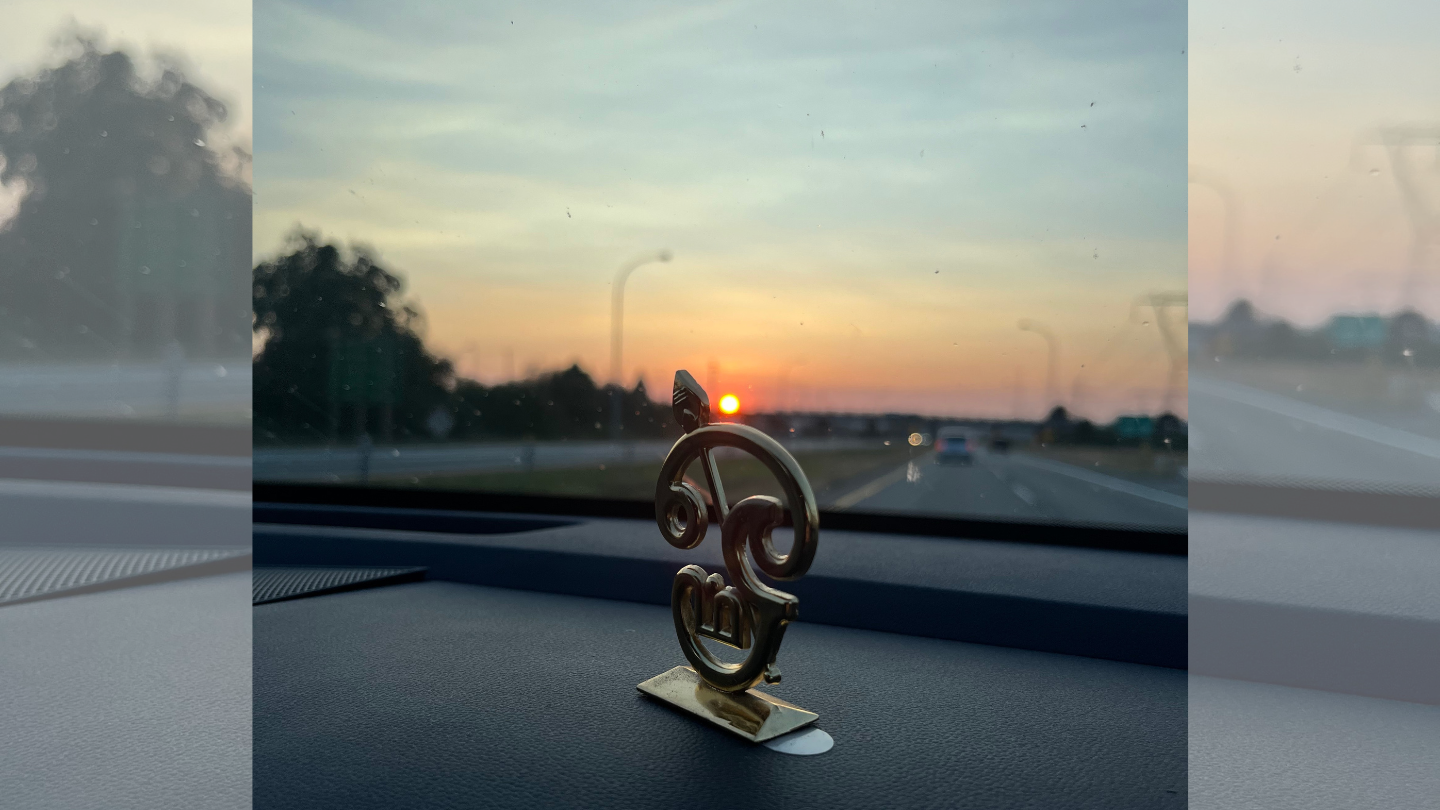
In the quiet embrace of the morning sun, I captured a moment that spoke volumes without uttering a single word. This image, bathed in the gentle glow of the rising sun, unveils a profound message through the sacred syllable "Aum" written in Tamil script. Tamil, one of the oldest languages, originates from and is widely spoken in Southern India, embodying a rich cultural and linguistic heritage.
This photograph is more than mere beauty; it encapsulates a depth of meaning that transcends language. "Aum," a syllable of immense significance, graces the frame. In Sanskrit, there is a specific term known as "अनाहत नाद," transliterated as "Anahata Nada" in English, which literally means "The Unstruck Sound."
In our tangible world, everyday-sounds arise from the collision or vibration of physical elements, such as air molecules or solid objects, creating waves that our ears perceive. This process underscores that sound typically necessitates the interaction of at least two elements. But beyond this realm of ordinary sounds lies the extraordinary - the sound of primal energy, the very sound of the universe itself. This is the "Anahata Nada," and it manifests as the simple syllable "Aum" or "Pranava" in Sanskrit.
In simple terms, Yoga can be described as a path to navigate life's journey, seeking to establish a connection with our innermost self and unite with cosmic energy. Yoga encompasses diverse paths that guide us towards ultimate realization, wherein we merge with supreme consciousness. Among these paths is "Nada Yoga," where "nada" signifies sound and "yoga" denotes union, thus Nada Yoga signifies the union with cosmic energy through sound.
In yoga, it is believed that sound manifests in four stages according to its frequency and subtlety: Vaikhari, Madhyama, Pashyanti, and Para. Let's briefly explore these four stages from a spiritual and scientific perspective.
Vaikhari is the audible sound, the grossest form of sound that we hear with our ears. It is the sound produced by the striking of two objects, such as when two stones are struck together or when we clap our hands. Vaikhari represents the most external expression of sound.
Madhyama is the intermediate stage of sound, which is more subtle and not audible to the physical ear. It represents mental sound or thought, where sound begins to take shape within the mind before it is spoken.
Pashyanti is a deeper, more subtle stage of sound, where it is visualized in the mind's eye. This stage is associated with the perception of sound in a non-verbal form. For instance, it parallels experiencing music in a dream state. When chanting a mantra audibly, it embodies Vaikhari; however, when the same mantra is mentally recited in meditation, devoid of external sound, it manifests as Pashyanti.
Para is the most subtle and transcendental stage of sound. It is the unmanifested sound, the source of all sound vibrations, residing in the deepest layer of consciousness. This stage is a transcendent sound with infinite wavelength, associated with the sound Aum. Para represents the primal energy sound, the ultimate source from which all sounds originate.
The beauty of "Aum" lies in its power and simplicity. Its vibrations are the cosmic heartbeat of existence. As an illustration, consider a person unable to speak; even they can chant "Aum" effortlessly, for this sacred syllable requires no movement of the tongue. You can try it yourself, feeling the resonance without the need for tongue.
Chanting "Aum" cannot be categorized as difficult or easy; rather, it's a practice that requires understanding and experience. With practice, it becomes effortless because, in its true sense, "Aum" is considered the sound of the cosmos, both inside and outside your body.
ॐ (Aum) is made of three Sanskrit syllables - अ (A), उ (U), and म् (M). The syllable अ (A) is pronounced as the 'a' in 'father', उ (U) is pronounced as the 'oa' in 'oat', and म् (M) is pronounced as the 'm' in 'sum' with a nasal sound.
To chant ॐ (Aum), begin by taking a deep breath in through your nose. As you start, pronounce the first sound "A" with your lips parted but not wide open. This "A" sound emerges from your gut, and you can feel its resonance there.
Now, as you gradually close your lips but not completely, transition to the second sound, "U." This sound arises from your chest and throat region, and you'll sense the vibrations throughout your chest, throat, and mouth.
Finally, when you fully close your lips, you create the "M" sound. This "M" sound originates from your throat and nasal region, and you can feel the vibrations encompassing your face.
This chanting process engages different parts of your body, creating vibrations throughout and connecting you with the cosmic sound, both within and outside your being. With practice, it becomes a natural and effortless experience.
In the stillness of this image, the ॐ stands as a testament to the profound connection between sound, the universe, and our inner selves. It reminds us that sometimes, a picture can convey a thousand words, but at other times, the image becomes beyond words, delving into the depths of existence and the simplicity of the sacred syllable “ॐ” (Aum).
Kevala Yoga Wellness | JUL 1, 2024
Share this blog post