
Mokshada Ekadashi and Gita Jayanti: Exploring Their Scientific and Spiritual Significance
Kevala Yoga Wellness | DEC 11, 2024
Introduction
As we discussed in our previous blog, the Hindu calendar, known as the Panchang, is based on cosmic activities. Therefore, each year, festivals and significant events are aligned with the cosmic events of that particular year. For a deeper understanding of the Panchang and the system of calendar and timekeeping, you can refer to our previous blog.
In this blog, we will talk about two significant events that fall on the same day: Mokshada Ekadashi and Gita Jayanti. Every year, these two events occur on the 11th lunar day (Ekadashi) of the fortnight of the waxing moon in the Hindu month of Margashirsha (Agrahayana), which corresponds to November–December in the Gregorian calendar.
What is Ekadashi?
First, let's understand the meaning and significance of Mokshada Ekadashi, where 'Mokshada' is a Sanskrit word that means liberation and "Ekadashi" is derived from Sanskrit, meaning the number 11 in Sanskrit counting. A month in the Vedic calendar is based on the lunar cycle. In one phase, the moon's digits increase over 14 days until it becomes a full moon, known as the waxing phase, or "Shukla Paksha" in Sanskrit. In another phase, the moon's digits decrease until it reaches a new moon, or no moon, completing the cycle, known as "Krishna Paksha" or the waning phase.
In simple terms, according to Vedic traditions, Ekadashi is the eleventh lunar day (tithi) from the full moon and the new moon. There are two Ekadashis in each month, which makes a total of 24 Ekadashis in a year.
From a calendar perspective, that explains what Ekadashi is. Now, let’s explore its scientific and spiritual significance.
Scientific and Spiritual Significance of Ekadashi
In a lunar month, the moon completes one 14-day cycle to reach the full moon and another 14-day cycle to reach the new moon. These phases of the lunar cycle influence various natural rhythms, including those connected to our bodies. According to yoga and Ayurveda, the human system, especially the mind and the water-based elements of the body, becomes more sensitive as the moon approaches its peak phases (full moon and new moon). This is why the days leading up to these phases are traditionally considered ideal for internal cleansing and balancing.
Vedic and yogic traditions explain that the 11th day is when the body’s natural energies are most supportive of fasting, detoxification, and stabilizing the mind. Instead of being a random choice, Ekadashi is intentionally placed at a point in the lunar cycle that helps prepare the system for the heightened sensitivity that occurs during the full moon or new moon.
In the Vedic understanding of time, each lunar day (tithi) carries a unique energetic quality based on the moon’s position and its interaction with other celestial forces. These shifting energies subtly influence the mind, prāṇa (life force), and the internal rhythms of the body. Just as some tithis are considered auspicious for action, learning, rest, or contemplation, the 11th day (Ekadashi) is traditionally regarded as a day when the moon’s radiance supports inner cleansing, heightened awareness, and deeper meditative states. The subtle lunar energy on this day is believed to make the body lighter, the mind clearer, and the prāṇa more harmonized, naturally aiding the process of fasting, introspection, and spiritual alignment.
Scriptural Basis for Ekadashi Fasting
The spiritual and physiological benefits of Ekadashi fasting are described in several sacred texts:
Padma Purana explains that Ekadashi is the day when sattva (clarity and purity) naturally rises, making it ideal for fasting and meditation.
Skanda Purana highlights that fasting on Ekadashi calms the mind and helps gain control over the senses, enabling deeper spiritual focus.
Bhavishya Purana states that Ekadashi purifies both body and mind, releasing accumulated impurities and supporting spiritual progress.
These scriptures emphasize that Ekadashi is designed to elevate both physical well-being and consciousness.
Benefits of Ekadashi Fasting for Body and Mind
According to Ayurveda and the above scriptures, fasting on Ekadashi:
improves digestion by giving the digestive system periodic rest
enhances mental clarity and reduces agitation
supports deeper meditation, as the mind becomes still and focused
cleanses toxins (ama) and strengthens digestive fire (agni)
balances subtle energies (prana), aiding emotional stability
Thus, Ekadashi is a holistic purification - physical, mental, and spiritual.
How the Ekadashi Fast Is Observed
The way one observes the Ekadashi fast varies depending on individual goals. Some people drink only water, completely abstaining from food, while others consume only water and fruits, and some may have proper meals. However, the core rule of fasting on Ekadashi is to avoid rice and grains, giving the digestive system a rest and focusing on cleansing. The food consumed should support this cleansing process. Millets, fruits, nuts, tapioca pearls, etc., are typically eaten, while rice and grains are avoided.
Additionally, fasting on Ekadashi helps prepare our bodies in the best and most natural way to align with the moon’s energy as it approaches the full moon or new moon. What we consume is absorbed and influences our body at different stages. In a subtle sense, our mind remains influenced by our food intake for 3-4 days. Therefore, fasting with a selective diet on the 11th day allows the body to absorb the food and cleanse itself optimally, supported by natural forces. This ensures that by the time the full moon or new moon arrives, our body is better aligned with the moon’s energy, which is important because the moon’s energy significantly influences both our physical and mental state during these phases.
This practice of fasting on Ekadashi is not only beneficial for physical cleansing but also holds deep spiritual significance. Rishis and yogis have used this method to prepare for deeper meditation. How profoundly our energy aligns with the full moon or new moon depends significantly on the state of our body. If our system and energy are already out of balance, the impact will feel unbalanced. However, if our energy is aligned and balanced, the impact will be balanced and profound. This is why, on Ekadashi, we take the time to prepare and align our body and energy.
This timeless practice has been followed by spiritual seekers throughout history to go deeper into their meditation and experience a profound state of balance and alignment, both within themselves and in their surroundings. Hence, fasting on Ekadashi serves as a tool for both physical well-being and spiritual growth.
Gita Jayanti: The Birth of the Highly Revered Bhagavad Gita
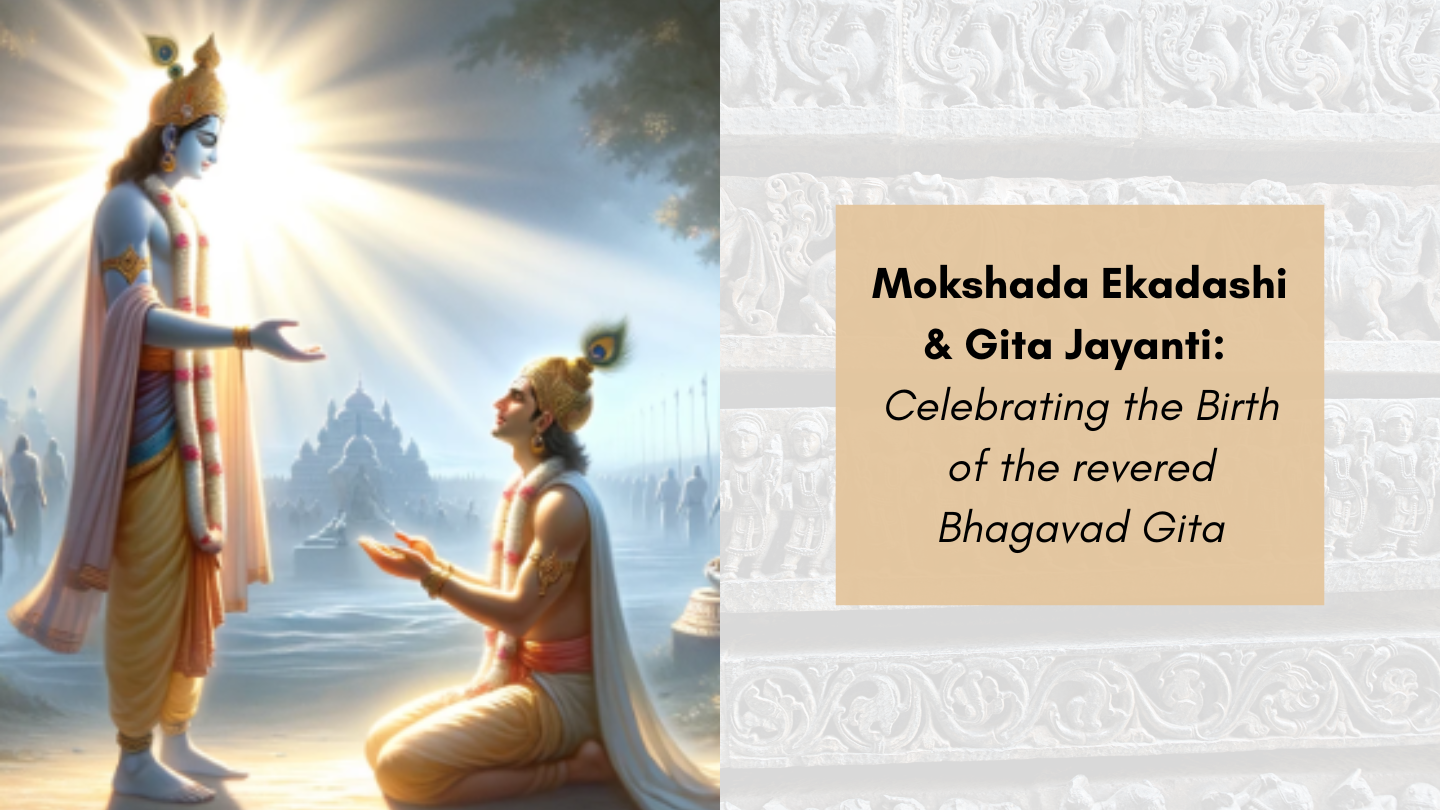
Now, let's talk about another significant event that falls on Mokshada Ekadashi, called Gita Jayanti, which marks the birth of the highly revered Vedic literature, Bhagavad Gita. The word "Bhagavad Gita" is a Sanskrit term meaning "the song of the higher energy." The Bhagavad Gita is a poetic text written in the Sanskrit language, consisting of 700 verses, structured into shlokas. The text is divided into 18 chapters, with each shloka composed of a couplet, making up a total of 1,400 lines. Each shloka contains two-quarter verses, each with exactly eight syllables. These quarters are further arranged into two metrical feet of four syllables each. Interestingly, the verses do not rhyme.
What is particularly remarkable about this revered literature is that all the 18 chapters end with the word "Yoga," such as Sankhya Yoga, Karma Yoga, Bhakti Yoga, Jnana Yoga, and more. Collectively, the chapters of this profound text cover various aspects of life, philosophy, and spirituality in a deep and meaningful way.
The Bhagavad Gita is a sacred dialogue between Arjuna, the warrior prince, and the divine teacher, or higher energy. Set in the midst of a great battle between two factions of the same royal family, Arjuna becomes confused and morally troubled about fighting in the war. His hands tremble as he envisions the bloodshed and the destruction that will unfold. The conflict, known as the Kurukshetra War, is fought between Arjuna's own relatives, friends, and teachers. In his moment of doubt, Arjuna turns to the divine teacher for guidance. The higher energy imparts profound spiritual wisdom, addressing Arjuna's questions about duty, righteousness, and the nature of life. The Gita covers various paths of yoga (spiritual practices), including Karma Yoga (the yoga of selfless action), Bhakti Yoga (the yoga of devotion), and Jnana Yoga (the yoga of knowledge).
The Gita was revealed to Arjuna at a time when he was faced with a moral dilemma, symbolizing the internal struggles we all face in life. Its teachings are meant to guide us through life's challenges, helping us to act with purpose, devotion, and wisdom. The Bhagavad Gita was born as a divine intervention to provide clarity and spiritual direction, offering timeless lessons on how to live a balanced, meaningful life.
Conclusion
In conclusion, timeless spiritual practices and ancient revered Vedic literature are deeply rooted in science. Together, they encompass every aspect of matter and energy in a profound way, offering a holistic understanding of the universe from both scientific and spiritual perspectives. These timeless teachings act as guides, helping us simplify and contemplate the complex journey of life. Though vast, these texts contain wisdom that can never be fully understood in a lifetime, which is why the guru system in yoga is of utmost importance - it allows us to absorb this vast knowledge under the guidance of an enlightened being.
Ultimately, it is up to each individual to determine their own journey and what they seek. The ultimate purpose of life is to keep our body and mind balanced and healthy while connecting with our true self. When we truly connect with our inner selves, we realize that the universe exists both within us and around us, and that both are one. To truly connect with and contemplate the outer and inner universe, it is essential to recognize and realize our own true essence.
Kevala Yoga Wellness | DEC 11, 2024
Share this blog post