Panchang: The Cosmic Science of Timekeeping and Our Interconnection with the Universe
Kevala Yoga Wellness | DEC 10, 2024
Time: Not Our Creation, but Our Interpretation
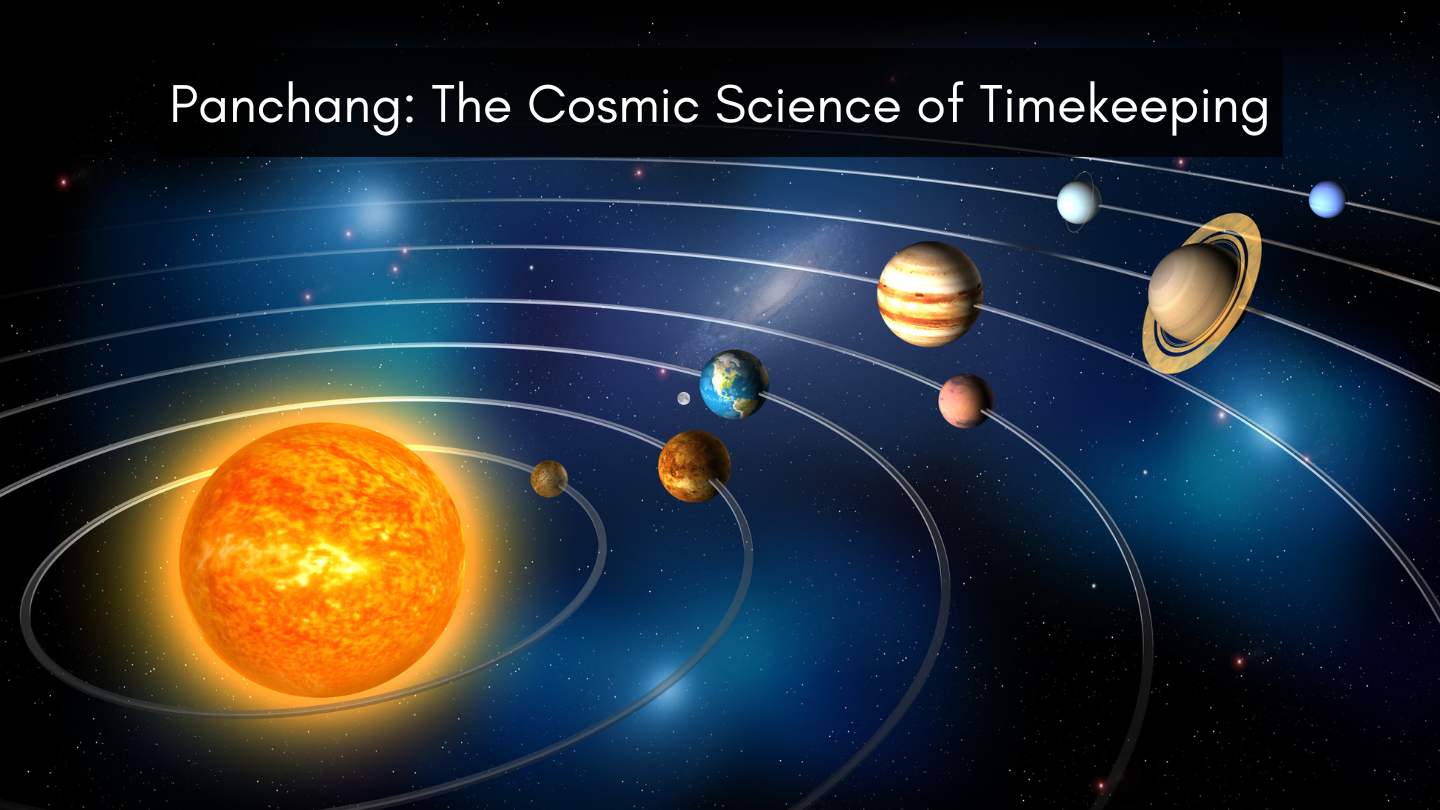
Time, as we understand it, is not a human creation. Instead, what we know it as today is an interpretation rooted in the science of cosmic activities and their precise calculation. The origins of mathematics itself stems from this cosmic understanding and interpretation. However, in modern times, for a common person who may not have an in-depth knowledge of these subjects, the concept of time has become overly simplified and limited. We often rely on our clocks and calendars to understand time in a fixed, rigid manner.
In this blog, we will explore the basics of how cosmic activities form the foundation of time as a concept. To understand this, we’ll dive into the ancient and profound system of the Panchang, which has existed long before writing was invented. Passed down through oral traditions for generations, this science has been a guiding tool for understanding time.
Panchang: A Profound Science of Timekeeping
The Panchang is a detailed and profound system of timekeeping based on cosmic activities. Even today, Indian traditions use the Panchang to set yearly calendars, which is why festival dates change every year. But beyond just the yearly calendar, the Panchang offers a comprehensive understanding of each month, week, and even day, as its calculations are refined based on cosmic movements. This allows for the precise tracking of time at various levels, aligning human life and energy with the continuous movements and subtle energies of celestial bodies, fostering a deeper connection with the universe's natural rhythms.
For example, consider Diwali - in 2022, Diwali was on October 24th, in 2023 it was on November 12th, in 2024 it was on October 31st, and in 2025, it will be on October 20th. The festival remains the same, but the date changes annually. Why is that? Because the calendar is based on cosmic activities. The exact dates for each festival depend on how cosmic events unfold during a particular year.
Every year, when the Sun and Moon conjunct in Libra during the months of October-November, Diwali is celebrated. This conjunction results in a new moon. From an astrological perspective, the Sun in Libra is in its debilitation (a weaker state), and the new moon also indicates a day with no natural light. This is why we light oil lamps during Diwali - to symbolically spread light when natural light is at its weakest. Along with lighting lamps, we also invoke the eternal light within ourselves. This collective illumination - both within and around us - removes darkness and fosters spiritual growth.
The Cosmic Alignment of Festivals
Another significant example is Navratri, a nine-day celebration honoring feminine energy and its value. Navratri aligns every year with the timing of seasonal changes. The science behind this lies in the fact that the occurrence of planetary (including the Sun and Moon) activities directly impacts the seasons. Based on these cosmic events, the dates for Navratri are set each year. The entire concept of timekeeping in the Panchang is deeply rooted in universal cosmic laws.
Similarly, every festival is determined based on these cosmic activities. Each event and celebration follows the alignment and interaction of celestial bodies, which is why their dates vary from year to year. This cosmic-based timekeeping ensures that human activities are in harmony with the universe's natural cycles.
The Five Limbs of Panchang: Cosmic Activities and Timekeeping
The word Panchang is derived from two Sanskrit words: "Panch," meaning five, and "Anga," meaning limbs. The system of Panchang is based on these five limbs. Each of these limbs has further sub-divisions, making it a precise and comprehensive system for calculating time based on cosmic activities.
In the following sections of this blog, we will explore the basics of these five limbs of the Panchang and understand how they interconnect with cosmic activities to give us a detailed understanding of time.
By understanding the Panchang, we delve into the timeless science of timekeeping, which encompasses much more than the simple ticking of a clock or the turning of a calendar page. It is a profound system that aligns the existence of life on earth with the rhythm of the cosmos.
The five limbs of this timeless science are:
1. Tithi (Lunar Day)
A Tithi represents the lunar day and is determined by the angular relationship between the Moon and the Sun. Specifically, one Tithi equals a 12-degree difference in the apparent positions of the Moon and the Sun in the sky. This difference is calculated as the Apparent Moon minus Apparent Sun. The Moon moves approximately 12 degrees in its orbit relative to the Sun during each Tithi.
The lunar cycle consists of 30 Tithis, which span about 29.5 days. These Tithis are divided into two phases:
Shukla Paksha (Waxing Moon): From New Moon to Full Moon.
Krishna Paksha (Waning Moon): From Full Moon to New Moon.
The relationship between the Sun and Moon, marked by the 12-degree angular difference, governs the lunar phases, shaping the cycle of time known as the Tithi. This celestial phenomenon is rooted in the orbital motion of the Moon and its interaction with the Sun’s light.
2. Vaara (Weekday)
Vaara corresponds to the seven days of the week, each named after a celestial body and ruled by a different planet. The characteristics of each day are influenced by the energy and attributes of the ruling planet, with each planet's position in relation to the Sun, Moon, and other celestial bodies affecting the energetic qualities of the day.
The Vaara system is deeply rooted in cosmic science, connecting planetary movements and their aspects with both earthly events and the existence of life on Earth. The seven days are as follows:
Sunday (Ravivar) – Ruled by the Sun, associated with vitality, leadership, and authority.
Monday (Somvar) – Ruled by the Moon, associated with emotions, intuition, and nurturing qualities.
Tuesday (Mangalvar) – Ruled by Mars, associated with courage, strength, and assertiveness.
Wednesday (Budhvar) – Ruled by Mercury, associated with intellect, communication, and adaptability.
Thursday (Guruvar) – Ruled by Jupiter, associated with wisdom, spirituality, and abundance.
Friday (Shukravar) – Ruled by Venus, associated with love, beauty, and creativity.
Saturday (Shanivar) – Ruled by Saturn, associated with discipline, structure, and responsibility.
3. Nakshatra (Lunar Constellation)
Nakshatras are 27 divisions of the sky based on the Moon’s orbit, marking specific positions in the zodiac. Each Nakshatra corresponds to a particular constellation or group of stars and plays a significant role in the interconnection and interaction of energies.
These 27 Nakshatras span the entire 360-degree zodiac, with each Nakshatra covering an angular distance of 13 degrees and 20 minutes. The stellar mansion in which the Moon is located, from the perspective of an observer at the center of the Earth, determines its energetic influence. Additionally, Nakshatras are divided into four quarters, each associated with specific energies that affect the nature of activities during that phase.
The scientific foundation of Nakshatras lies in the Moon’s motion and its alignment with various stars. This dynamic interplay between the Moon and the stars influences both cosmic and earthly events, providing a framework for understanding the subtle energies at play in the universe.
4. Yoga (Combination of Sun and Moon’s Positions)
(Please note that the term 'Yoga' has a wide range of meanings and applications depending on the context. The 'Yoga' referred to here is a specific concept related to cosmic energies and differs from the asana form of Yoga typically practiced for wellness).
Yoga is a specific combination of the positions of the Sun and the Moon, which results in an energetic influence on the day. There are 27 different Yogas, and each represents a unique combination of angular distances between the Sun and Moon.
The calculation of Yogas is based on the longitudinal positions of the Sun and the Moon in relation to one another. The scientific foundation behind Yoga lies in the gravitational and energetic effects these celestial bodies exert on Earth. The alignment between the Sun and Moon creates varying forces that impact both natural phenomena on Earth and human activities, with certain Yogas believed to be more favorable for specific endeavors, while others may be less auspicious. This concept bridges celestial dynamics with human experience, highlighting the interconnectedness of cosmic forces and life on Earth.
5. Karana (Half-Day Unit)
Karana is a half-day unit that divides each Tithi into two parts. Since a Tithi lasts for approximately 24 hours, it is split into two Karanas, each lasting roughly 12 hours. There are a total of 11 different Karanas, and their influence is believed to affect the nature of the day, such as whether it is favorable for certain activities.
The scientific basis for Karana lies in the Moon’s motion. Since the Moon’s position determines the Tithi, and the Moon moves about 13.2 degrees per day, each half of the Tithi (or Karana) has distinct characteristics influenced by the Moon’s phase and position within the zodiac.
Each of the five limbs and their subcategories collectively form the comprehensive and detailed science of the Panchang. Tithi, Vaara, Nakshatra, Yoga, and Karana work together as a precise and interconnected system that tracks cosmic activities. These limbs provide a holistic understanding of time, aligning the existence of life with the natural rhythms of the cosmos. By considering the movements of the Sun, Moon, and other celestial bodies, the Panchang offers a framework that goes far beyond simple hours and minutes. It deeply connects timekeeping with universal laws and natural phenomena. Rooted in astrology and astronomy, this ancient science continues to guide us in harmonising our lives with the forces of the universe.
In conclusion, the Panchang, in very simple terms, is like a mirror of the sky at any given moment. Our understanding of science, methods of calculation, and systems of timekeeping all stem from the interpretation of cosmic activities. These celestial movements are the only absolute measure of time, guiding humanity since the beginning of existence. While we have standardised and generalised time in modern life, the foundational laws of the universe remain unchanged. Even the modern clocks and calendars we use today trace their origins back to the interpretations and understanding of this ancient science.
Kevala Yoga Wellness | DEC 10, 2024
Share this blog post